
PREDICTIVE TEXTILE ARCHITECTURE:
Weaving Architecture: Eliminate Waste, Design with Precision.
A working framework for textile designers and educators — calculate exact fiber use through digital drafting, before you mount a single thread.
Traditional weaving is a craft. Weaving Architecture is a method.
Most handweaving relies on trial and error — you don't know exactly how much fiber you'll need, or how a piece will behave, until it's already on the loom. We built Luna Pastora Studio to change that. By bringing environmental science and predictive modeling into the process, every project starts with real numbers: exact fiber allocation, verified color harmony, and structural tension calculated before a single thread is mounted.
Weaving Architecture is a technical framework .


I. Digital Suite (The Intelligence)
Predictive Modeling, not guesswork.
Our browser-based suite — TCLAB™, IMDRAFT™, TDLAB™ and FWLAB™ — lets you preview color harmonies, calculate exact fiber, dye requirements, and plan structure before you weave. Built for studios and classrooms that can't afford to waste premium fiber on trial and error.
II. Engineering (The Hardware)
Comfortable to weave on. Easy to store. Ready to travel.
The Travelling Loom™ and Pampa Loom® systems are engineered for efficiency — compact, portable, and paired with continuous-thread protocols that can cut weaving time by up to 50%. Built for bespoke garments, accessories, and art pieces, with zero-waste geometry at the core.
III. Couture (The Collection)
Physical Proof of Concept.
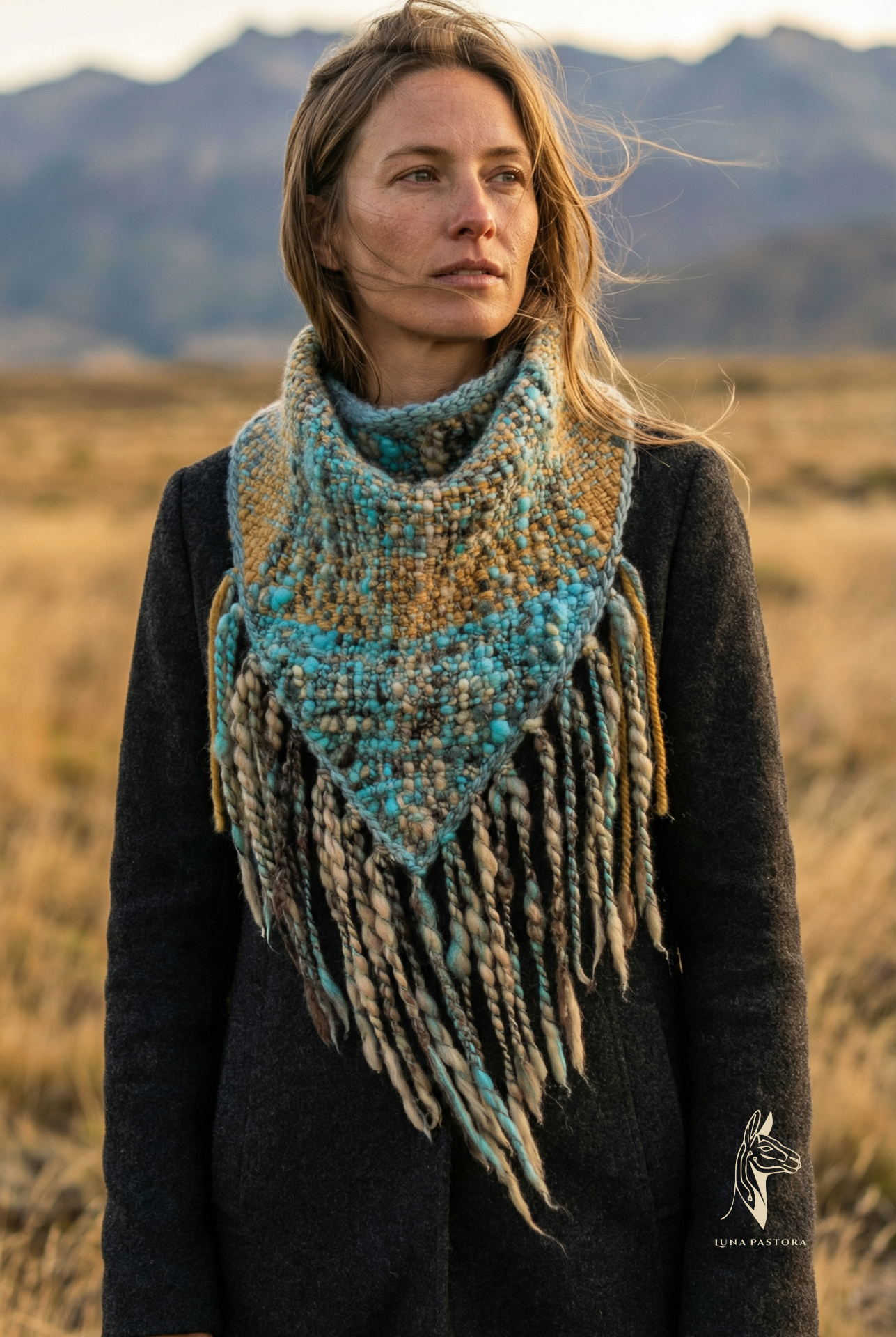
Our limited-edition pieces, woven in 100% natural fiber, are where the LP-DNA™ Protocol meets the loom — in two directions at once. The same mathematical framework that calculates a precise plaid grid, based on color theory and exact thread sequencing, also maps the freeform placement of hand-spun art yarn. Structure or improvisation, the math holds up either way.
Scientific Direction & Innovation
Luna Pastora Studio is led by Lic. Marcela Mesquida — environmental scientist, weaver, and lead researcher. She built the LP-DNA™ Protocol by applying the same geospatial precision she once used mapping terrain to something much smaller: the loom.
What does cartography have to do with weaving?
More than you'd think. A satellite map organizes a landscape into coordinates and data layers. The LP-DNA™ Protocol does the same thing for your weaving grid — converting it into a digital coordinate system that projects tension, shrinkage, and color distribution with millimeter precision, before you weave a single row.